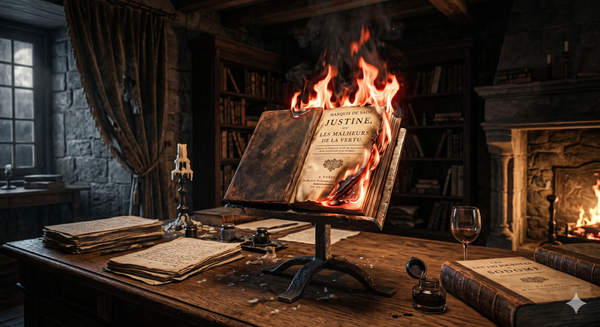
Should We Burn the Marquis Sade? Or Should We Keep Him by Our Bedside?

I discovered a video game on my Instagram reels that I am hesitant to reveal the name of. This game has been removed from itch.io and is not available on Steam because it does not meet the platform’s requirements. It can be purchased through methods such as sending USDT to an email address. Consequently, organizations have tried to prevent the public from seeing it as much as possible. A game that, at the extreme end of violence and sexuality, is disturbing to some and, according to others, could corrupt one’s morals.
Me, on the other hand, it left me feeling conflicted. While one part of me was filled with that sudden sense of impurity and disgust created by the game, the other part of me was telling me that life all over the world had been exactly like this for a long time. So what would be the outcome of a clash between that brutal, power-driven reality -the “ordinary events”- that humanity experienced throughout most of history and prehistory, and my own sanitized morality as a modern-day person? How was I supposed to feel? Does this kind of radical content desensitize us to cruelty (meaning, is censorship justified), or does it remind us of that great human suffering we have forgotten?
At this point, I remembered some works I had encountered in the past that had a similar effect on me: the works of the Marquis de Sade and Pier Paolo Pasolini’s Salo, or the 120 Days of Sodom. Should these have been censored as well? Could we have known the artist’s true intent, or the purpose for which the work would be used by the consumer?
Perhaps this had something to do with the limits of art and the ethics of the “media form.” Ultimately, when watching the film Salo or reading The 120 Days of Sodom, there is an “artistic distance” between the reader or viewer and the work. We are witnesses who watch in horror as the bourgeoisie, fascism, or power objectify the body. However, in interactive media, a sense of “agency” comes into play. Games eliminate this distance. The player is not a passive spectator; they are drawn into the mechanics and must follow the rules of that wild world to survive.
In other words, if the author of the story is responsible for everything that happens, then the player becomes partly responsible through the choices they make. This explained the unease I felt. While simply reading allows us to preserve our morality to some extent as “witnesses,” in an interactive world, when we treat this monstrosity merely as a “game mechanic” with every click, the cruelty ceases to be a cautionary tale and transforms into a matrix of entertainment, a mere toy. When artistic distance is lost, all that remains is the interactive consumption of raw exploitation. Or is that how it works?
To find the answers to these questions, we must examine the immense paradox in the life of the Marquis de Sade, one of history’s most controversial writers. This aristocrat, whom popular culture has dismissed as merely a “creator of perversion,” was in fact the greatest mirror held up to the sterile, rational, and humanist lie of the Enlightenment, the notion that “man is the measure of all things.”
Sade’s radical philosophy of nature was simple: Nature is amoral, cruel, and destructive. Nature must destroy the old to bring forth new life. Therefore, murder, violence, and domination are not contrary to nature; they are the true expression of that irrepressible reptilian brain within man -that is, raw nature. Religions, laws, and morality, on the other hand, are false shackles invented by the weak to limit this natural right of the strong.
Yet the life of the Marquis, who put this dark philosophy into writing, is a veritable tragicomic paradox. After spending decades in the cells of the Bastille, Sade was released when the French Revolution broke out. He redefines himself as “Citizen Louis Sade” and takes his seat as a judge in the revolutionary tribunals.
Here lies the greatest paradox in human history: this man, who in his books sanctified incest, torture, and mass slaughter with the most cold-blooded philosophical arguments, rejected nearly all the death sentences brought before him while sitting on the bench. He releases the accused, opposes the death penalty, and is eventually removed from office -deemed “too merciful and lenient for the revolution” in the eyes of the regime- only to be thrown back into prison by his own comrades.
This paradox is at the heart of my essay. In real life, Sade was not a sadist or a murderer; he was a terrorist of the mind. His aim was not to actually destroy people, but to expose society’s hypocrisy.
Sade was repulsed when he saw that during the “Reign of Terror”, which emerged during the Revolution, the state had guillotined thousands of people in the name of “the public good, virtue, and freedom.” For he openly defended that savagery as a personal pleasure, an amoral law of nature; yet the modern state and its institutions institutionalized the same savagery by hiding it behind the mask of “goodness, law, and civilization.” It wouldn’t be too far off the mark to conclude that, for Sade, the greatest sin was not monstrosity itself, but the polite robe of law draped over it.
Sade was a mirror that scraped away civilization’s thin veneer to reveal the reptilian brain beneath. And today, interactive media takes that mirror and places it directly into our hands.
When Friedrich Nietzsche proclaimed that “God is dead,” he was not merely heralding the end of a theological system; he was announcing the collapse of that absolute, transcendent moral center that held humanity together and protected it from its own savagery. Ancient cultures and religions succeeded in reining in the primitive impulses of the amygdala -that dark “reptilian brain” within us- including the desire for violence and the thirst for domination—through fear, ritual, sin, and sacred taboos. Humanity had become civilized thanks to the belief in the existence of a higher authority that constantly watched over and punished them. Even though we cannot know for certain whether they truly believed this deep down (just as we cannot know how sincerely people believe in today’s idols), they had already established the rules.
When the modern rational Enlightenment dethroned this transcendent authority, humanity did not become free; on the contrary, new and far more savage secular idols were placed on the vacant throne. The State (Leviathan), as ideologized by Thomas Hobbes, was marketed as a rational shield protecting us from tearing one another apart. Yet what the state actually did was not to eradicate the savagery of the reptilian brain; rather, it monopolized violence, endowing it with a flag, a bureaucracy, and an army. Positive Law, which replaced divine revelation, transformed into a mechanical instrument of oppression safeguarding the property of the ruling class. While liberalism isolates the individual from social bonds, atomizing them and trapping them in the illusion of false individualism; the capitalist economy has turned endless exploitation into a rational religion.
The reason these modern idols are crumbling today is not that human nature is uncontrollable; it is the inherent rot within these hierarchical structures. The monstrosity that seeps out from beneath the thin, hypocritical veneer of civilization is not an evolutionary curse of humanity; it is the very systemic violence that the state and capital have organized for centuries in the name of disciplining humanity. This is precisely why a game can shake us to our core and fill us with dread: It does not show us what becomes of humanity when authoritarian institutions collapse, but rather how authoritarian structures transform people into monsters and fragment them. Systems do not protect us; on the contrary, they legitimize their own existence by turning us against one another.
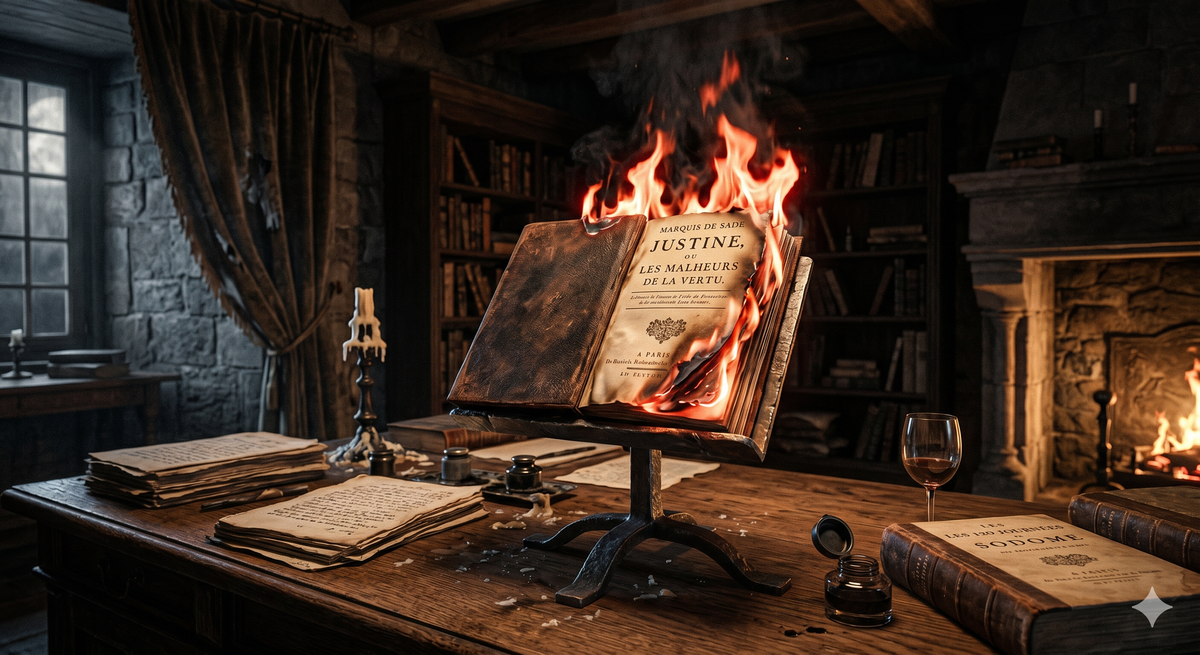
So let’s get back to the ultimate question: Should we burn Sade, or place him at our bedside?
Burning Sade and his modern incarnations in the digital age -censoring or ignoring them- is the oldest reflex of an authoritarian mindset. Those in power always choose to shatter the mirror to render the darkness they have created invisible. This is precisely why Sade must stand at our bedside. We must place him there not as an object of admiration, but as the most radical warning sign demonstrating just how much power, property, and absolute authority can turn a human being into a monster.
Sade’s raw, amoral texts reveal to us the ultimate destination of hierarchy and domination. His revulsion, as a revolutionary judge, at the guillotine’s “cold, rational, and virtue-masked” brutality under the Jacobin state is the first spark of anarchist critique. Sade whispers to us: The most dangerous monster is not the savage roaming with a whip in hand; it is the institution that claims to have a monopoly on justice and morality.
So, how will we build a new way of life amidst the postmodern ruins where these hierarchical structures have crumbled?
The solution does not lie in patching up the old system with new laws or creating even more tyrannical Leviathans. What we need is a new social operating system kernel, an “Open Source Canon” architecture at the dawn of a post-Western era, one that completely rejects vertical authorities and centralized power structures and honestly acknowledges human frailty and power.
This new structure must be built through communities that are horizontal, autonomous, and voluntary; communities where power is not concentrated in a single center and where hierarchical chains of command are replaced, much like in mesh networking systems. What we need is not dogmatic laws dictated from the top down; rather, it is to write a flexible moral core (kernel) that is constantly updated through collective wisdom and rational debate from the bottom up, where every individual can freely contribute.
Sade must remain open, right there on that mantelpiece, right next to the flames. We must shudder at the sight of that ultimate nightmare of domination that authority can create within the human spirit; but with the strength we draw from that shudder, we must build -line by line- that free, horizontal, and open-source world where we will not trample one another, without needing the false protection of states and markets. Because true order is not authority imposed from above; it is freedom sprouting from below.
24 May 2026 - Montreal