In the Shadow of the Eye that Never Sleeps: The Dialectic of Privatization and Digitalization of Violence

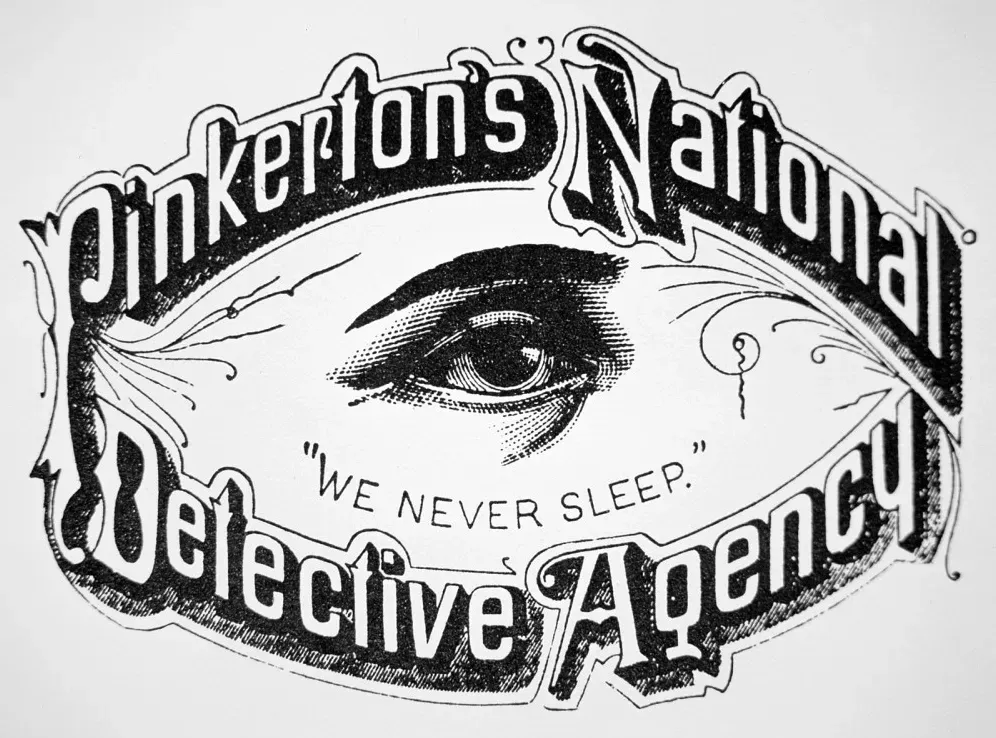
The Pinkerton Detective Agency is an independent police force founded in Chicago in 1850 by Allan Pinkerton. What makes this company significant in my view is that it is an integral part of all the sociological and governance changes the United States has undergone, and that we can trace a trajectory through it. The Pinkerton Company’s famous logo features an open eye, with the words “We never sleep” written below it. This eye can actually be interpreted not merely as an advertisement, but as a symbolic representation of a panopticon prototype that fills the gap in the U.S. government’s capacity to surveil and monitor. To summarize the points I will discuss in the remainder of this text: The history of the Pinkerton Agency is a summary of the process by which the U.S. government established, maintained, and ultimately transferred the monopoly on violence to capital.
We can say that the period between 1850 and 1880 marked the company’s early years. The FBI did not exist yet, the federal army was limited, and Manifest Destiny was at its peak. In the Wild West during the golden age of cowboys, the law was only as strong as the landowner’s gun. Civilization had not been established yet. To be clear, by “civilization” here I mean a world where land had not been parceled out and everyone was free to do as they pleased. In short, the times and places where the U.S. had not yet established the state’s “monopoly on legitimate violence” in the Weberian sense in the frontier regions.
In 1861, U.S. President Abraham Lincoln was set to travel by train from Springfield to Washington, D.C., to take the presidential oath of office. At that time, Southern secessionists were plotting to assassinate Lincoln even before the war had begun. Allan Pinkerton and his team—with the help of Kate Warne, the first female detective—infiltrated the assassination cells in Baltimore and uncovered the plot. According to the plan, Lincoln was to be stabbed in the crowd while changing trains. Pinkerton put Lincoln on the train one ahead of schedule, disguised as an disabled passenger and using a pseudonym. He also cut the telegraph lines to prevent any potential news from getting out. This incident earned Pinkerton a tremendous public relations success and the title of “the man who protects what the government cannot.” The Pinkertons' unconventional methods, such as disguising, were not well received. Consequently, the relationship broke down in the years that followed, but by then the incident had already secured the prestige the company needed.
If we return to the Wild West, we must recall Charles Tilly. “War-making and state-making qualify as our largest examples of organized crime.” Contrary to popular culture, the Wild West (Frontier) was not a lawless place; it was simply a place without a government. As the United States expanded westward across the continent, it had asserted its sovereignty on paper, but it lacked the means to enforce that sovereignty on the ground. The jurisdiction of local sheriffs ended as soon as the town limits were crossed, and it was impossible to pursue a criminal who had crossed state lines. It is worth remembering that the FBI was established in 1908.
At this point, Allan Pinkerton developed a groundbreaking business model. He established the first organization with a centralized intelligence network that operated across state lines. This model offered the “geographical reach” that the government could not provide as a commercial service. If you were going to track down a fugitive back then, the agency you needed to contact wasn’t the government—it was the Pinkertons. The Pinkertons were hunting down folk heroes—such as Jesse James and his gang—who supported the Confederacy and opposed the railroads and banks (that is, the new capitalist order); as Eric Hobsbawm put it, these were “social outlaws.” While the Pinkertons were hunting down these folk heroes, they were actually sending this message to the emerging middle class: Order and stability are only possible through respect for property. The Pinkertons didn’t just chase criminals; they brought discipline to the wild and lawless American frontier.
But that was not their real business. Between 1850 and 1880, American capitalism rose to prominence through the railroads. Trains carried not only passengers but also capital, weapons, and state authority. For railroad barons like Vanderbilt, Gould, and Stanford, their investments were too vast to leave their security in the hands of the state. Train robberies were not merely a public safety issue; they meant a drop in the value of their stock. The Pinkertons operated here not as the state’s police but as the “immune system” of private property. The pursuit of a crime was carried out not for “justice” but for “compensation for damages.” Moreover, they aimed to deter potential individuals who might harm their customers.
Unlike the state’s “measured and lawful” violence, Pinkerton’s violence was uncontrolled, punitive, and theatrical. Despite the limited communication options of the time, the Pinkertons had established an extensive “filing” system. They were able to circulate photographs of criminals throughout the country. It was a claustrophobic surveillance mechanism that instilled a sense of “nowhere to run” in the minds of criminals. However, to illustrate their “wilder” side, we must turn to the Raid on the Jesse James Ranch. Unable to capture Jesse James, the agency decided to ramp up the “fear factor.” Pinkerton agents raided the home of the James brothers’ mother in the middle of the night. Even though they knew there were no criminals inside, they threw an incendiary device into the house, killing Jesse James’s 8-year-old stepbrother and causing his mother to lose her arm. The message they were trying to convey was quite clear: If you do not comply with discipline, we will not hesitate to use force.
In addition to all this, capital and the government needed the Pinkertons for one more reason. During the process of “clearing” the land through which the railroad was to pass, the government’s military forces were sometimes too slow or ran into legal obstacles. The Pinkertons stepped in to expedite the process in gray areas where the state did not want to officially intervene—such as in conflicts with indigenous peoples or property transfers. Before violence could be cloaked in the guise of “law,” it was “practically” resolved by the Pinkerton’s gun.
Following the Reconstruction era—which encompassed the repair of the damage caused by the American Civil War—the Gilded Age began. Naturally, in this new organizational structure, the Pinkertons were also assigned new tasks between 1880 and 1900. Following the industrial North’s victory in the war, a wave of industrialization began to sweep across the entire United States. The new model of production was spreading throughout the country. At this point, the target of the Pinkertons, capital, and the state was no longer the horseback bandits who stole cattle, but the factory workers. The purpose of violence has shifted from protecting property from thieves to protecting it from workers.
By the 1890s, the Pinkertons’ ranks exceeded the number of active-duty soldiers in the U.S. Army. For the government, this was both a convenience and a “threat to sovereignty.” The agency hired the unemployed and the lumpen proletariat and set them loose against the organized working class. This was a class-based “divide and conquer” tactic. The Pinkertons didn’t just carry out armed raids; they infiltrated unions, incited workers, and leaked information “from within.”
The 1892 Homestead strike is perhaps one of the most significant events in the company’s history. Andrew Carnegie and Henry Clay Frick hired 300 heavily armed Pinkerton agents to break the steelworkers’ strike. This event is also one of the most significant in American labor history. The Pinkertons clashed with the workers as they attempted to infiltrate the factory by river. Between 7 and 9 workers were killed, and 3 or 4 Pinkerton agents who surrendered were lynched by the workers. Dozens of others were injured. Carnegie chose to pay the Pinkertons rather than request troops from the government. This was because the state army was bound by laws; the Pinkertons, however, had the freedom to enforce the property owner’s “right to protect his property” in the most brutal manner. With the army’s intervention, the strike was broken, and the workers were forced to accept the employer’s terms. This event marked the end of an era for the Pinkertons. The word “Pinkerton” became synonymous with “fink,” one of the harshest insults in labor slang. The U.S. Congress, however, passed a resolution in 1893 prohibiting the federal government from hiring private detectives or mercenaries. Another detail worth noting is that the Homestead strike was the main factor that led Emma Goldman and Alexander Berkman to decide to assassinate Henry Clay Frick. I would like to mention this as well.
The Pinkertons gradually faded into obscurity after the 1893 law, as the government succeeded in establishing a monopoly on security.
Or so it seemed.
Although their influence waned throughout the 20th century, the Pinkertons continued to combat strikes. But then something happened. The neoliberal era arrived. Naturally, Pinkerton had to adapt to the times. In 1999, Pinkerton’s was acquired by Securitas AB, a Sweden-based security firm.
By 1892, the previous frontier had closed. Today, however, there is a new frontier: the internet, data, and cloud computing. The internet is a “modern Wild West” where the rules have not fully taken hold yet and the government's regulatory capacity lags behind that of giant corporations (or at least it was in the early 2000s). I remember this “Wild West” era of the internet from my childhood. The internet is no longer as free a place as it used to be.
It is no longer land that needs protecting, but data. The Pinkertons no longer patrol on horseback, but in server rooms. Documents leaked from Amazon in 2020 proved that the Pinkerton Agency was hired to monitor workers.
In the past, a Pinkerton agent would turn on a striker; today, algorithmic systems push workers with a tendency toward unionization out of the system by labeling them as “low performers” or “discipline issues.” Analyzing the data before a strike even takes place to eliminate the “possibility.” This is the most refined form of Pinkerton’s “The Eye that Never Sleeps”. Silicon Valley companies also rely on Pinkerton to ensure their digital security and for assistance in the field of cybersecurity.
By transferring its monopoly on violence to the private sector, the state is effectively demonstrating a deliberate failure to act. When the state commits a violation, it can be held accountable; however, when a private security firm or an algorithm makes a “mistake,” responsibility becomes anonymous. Perhaps this is where we might recall Yanis Varoufakis’s concept of ‘Techno-feudalism.’ Society may well split into two groups: those who can “buy security” (gated communities, privately insured digital spaces) and those “left vulnerable to violence” (public spaces, those whose data is stolen).
Structures like Amazon or Google having their own security forces, their own legal systems, and their own data borders. This is a technological replica of the feudal system of the Middle Ages. In his book, Varoufakis discussed techno-feudalism as a form of market control. In addition, we can say that today’s Silicon Valley companies are increasingly resembling feudalism in terms of security.
Perhaps the only salvation lies not in handing over the security of property (data) to Pinkerton-like entities, but in reclaiming that security through open-source, transparent, and public tools. The Pinkertons, who once served as bodyguards for railroad barons 150 years ago, are now writing algorithms for data barons. If violence has become commodified, perhaps the only true act of rebellion is to refuse to buy into this commodity?
14 April 2026 - Montreal