Generational Metabolism: Institutional Stagnation and the Responsibility of the New Generation

History has no predetermined course, no mystical purpose, and no secret, repetitive script. However, there are two immutable material realities of human societies: the finite lifespan of human biology and the fact that institutions become rigid over time, losing their flexibility. The biological aging of a dominant generation that holds power, coupled with the inability of the systems they established to respond to changing technological and economic realities, creates breaking points in history. These breaks evolve into structural generational reckonings at intervals of roughly 40 to 50 years.
Today, the major impasse in global and local politics during the second half of the 2020s is not the alarm of a cosmic clock; it is the natural consequence of the current institutional structure reaching its biological and structural limits. And the responsibility for resolving this impasse rests on the shoulders of those born between 1980 and 2000, based entirely on rational and materialist grounds.
I prefer to illustrate this situation entirely through the cycles of government in Türkiye’s political history.
The Pressure of Material Conditions and Generational Gaps
No generation in Turkish political history has ever brought about a radical break simply out of ideological romanticism or the fantasy that “we are more progressive.” What drives generations to revolt and overthrow the old order is the economic gridlock, the collapse of security mechanisms, and the fact that the tools at the disposal of the ruling class are no longer capable of physically sustaining the country. In other words, the break is not an intellectual luxury but a material survival reflex.
Two major turning points in Turkish history are the most stark examples of this material imposition:
- The Generation of 1880: The Empire’s Bankruptcy and Logistical Collapse:
What compelled the military staff born in 1880s (Atatürk, Enver, İnönü) to make radical decisions was not merely the Ottoman Empire’s intellectual obsolescence. They were faced with a state that was completely bankrupt in material terms.
The Düyûn-u Umûmiye (General Public Debt Administration) was established to collect payments on the Empire’s debts to other countries, and the government’s future tax revenues had been seized. Financial independence had been lost; by the time of the Balkan Wars, the army had run out of boots to issue to soldiers and ammunition to send to the front. While cholera epidemics were decimating the armies, the older generation of bureaucrats was still trying to buy time with the 19th-century “diplomatic balancing acts”. In other words, the government was dominated by an elderly class of people trying to live according to the paradigms of a bygone era. This ruling class consisted of the remnants of the revolutionary youth of the 1840s.
What compelled Enver Bey, at the age of 31, to storm the Bab-ı Ali (The name given to the Grand Vizier's palace, i.e., the government), and Mustafa Kemal, at the age of 38, to land in Samsun, was the fact that there was no longer any physical state apparatus left to govern. The old generation’s cumbersome administrative structure could not keep pace with the speed of the telegraph and modern logistics. The young officers seized power because, otherwise, there would be no land left for them to live on. These figures were not exceptional for their time. All their contemporaries possessed a similar self-confidence and were engaged in similar activities.
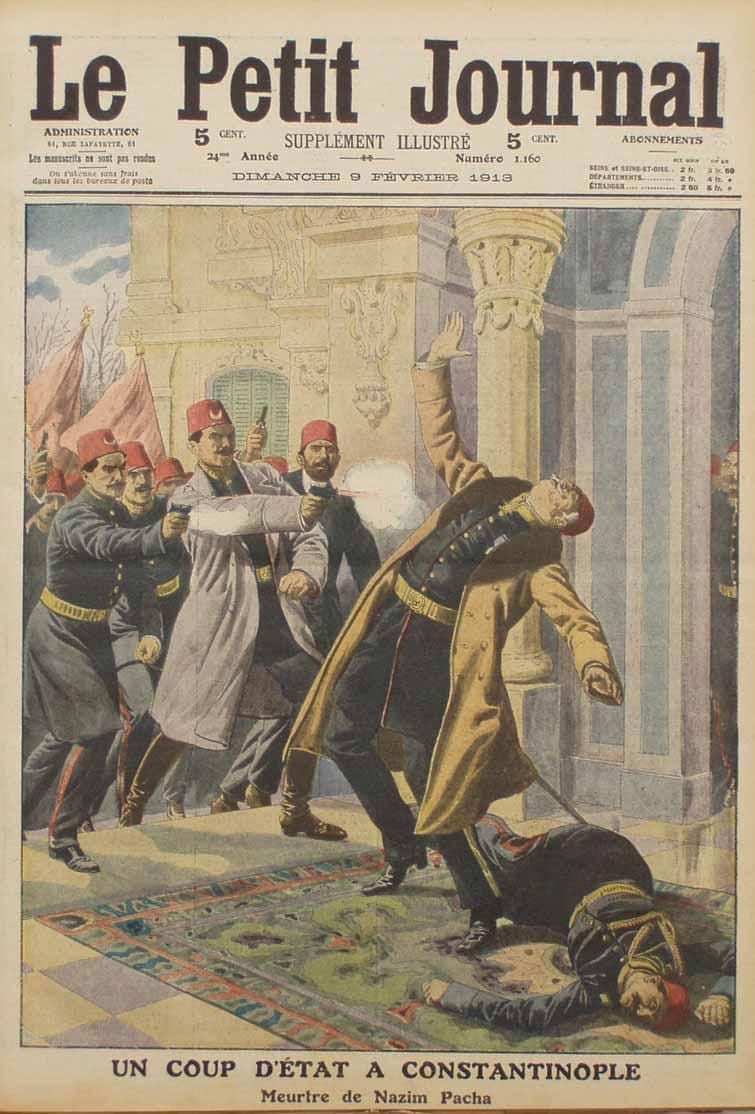
The first and most radical known event in Turkish politics in which the younger generation took the stage, declaring, “We no longer have time to wait,” was the 1913 Bab-ı Ali Raid. The ruling elite (the Kamil Pasha government) was a cumbersome and helpless cabinet of elders that had reached the point of ceding Edirne, the former Ottoman capital, to the Bulgarians following the humiliating defeat in the First Balkan War. Enver Bey, the iconic figure of the 1880 generation (the Committee of Union and Progress), rode up to the gates of the Bab-ı Ali on his white horse at the age of just 31. Accompanied by a handful of young officers, he entered the building, stormed into the Grand Vizier’s office, and forced him to sign his resignation at gunpoint.
This incident is the first well-known concrete example of a generation that had become obsolete in Turkish politics being ruthlessly purged by a young and radical cadre in the name of the state’s survival. The leaders who founded the Republic (Atatürk, İnönü) also emerged from this “self-assured” generation. After the 1913 coup, despite their young age, this generation effectively took control of Türkiye’s government.
- The Second Great Showdown: The 1972 CHP Convention (Ecevit vs. İnönü)
The founding generation (the 1880s) saved the state and built the new regime. However, as that same group grew old, it turned into a barrier blocking the path of those coming after them. The most dramatic example of this is İsmet İnönü.
By the early 1970s, İsmet Pasha -a “gray-haired veteran” nearing 90- was at the helm of the Republican People’s Party (CHP). He was attempting to manage the rising tide of the left, the street protests, and the dynamism of the youth both in Türkiye and around the world using the old state reflexes.
Bülent Ecevit, the “young” figure of the era (and the winds of the ’68 movement behind him), challenged İnönü at the 1972 party convention. Despite İnönü’s immense historical charisma, Ecevit won the convention and orchestrated the greatest generational transition in Turkish political history. İnönü did not want to relinquish his seat; the new generation tore it from him right in the convention hall.
Neither of these ruptures was a historical necessity; rather, they were explosions resulting from the rational contradiction between outdated institutional mechanisms and the material realities of the new world.
In other words, the generation that grew up with trains had stopped respecting the generation before them, and the generation that grew up with the radio did exactly the same thing to the generation that grew up with trains
Institutional Entrenchment and the Barrier of Gerontocracy
In Turkish politics, institutional ossification is not an abstract governance problem; it is a concrete barrier to power, reinforced by legal, regulatory, and financial mechanisms. In our country, political parties and the state bureaucracy are not structures that renew themselves organically. On the contrary, they function like feudal castles seized by a single generation or leadership cadre, which then tightly shut their doors to those coming after them. The primary building blocks of these fortresses’ walls are gerontocracy (rule by the elderly) and the institutional blindness it creates.
We can see how this barrier operates in Turkish political history through three specific dynamics:
A) Legal and Statutory Framework: The Political Parties Law and the Delegate System
There is a very clear financial barrier preventing younger generations from rising through the ranks in Turkish politics: undemocratic party bylaws and the current Political Parties Law. The entrenched leadership, sitting comfortably in their seats, personally selects the provincial and district organizations, and thus the delegates who will elect them. The delegates elect the leader, and the leader appoints the delegates. This closed-loop system does not allow any fresh blood, new ideas, or the younger generation to rise through the ranks. This barrier, which Enver Pasha breached by force in 1913 and Ecevit breached with an extraordinary popular upsurge in 1972, has been fortified far more professionally today. Today, political parties are no longer institutions that generate ideas; they have become corporations dedicated to preserving the status quo of the leader and the narrow circle of elderly elites surrounding him.
B) A Historical Mirror: The Legacy of the “Unwilling to Leave” of the 1990s and the Collapse of 2002
Türkiye has paid a very heavy price for this institutional rigidity in the past. The quartet of Süleyman Demirel, Bülent Ecevit, Necmettin Erbakan, and Alparslan Türkeş, who entered politics in the 1960s and 1970s, completely blocked Turkish politics for exactly 35 years.
Institutions had become so entrenched and inflexible that, as the world entered the Internet age, these entrenched elites plunged Türkiye into the 2001 economic crisis. The system had become so gridlocked that, in the 2002 elections, the public wiped those entrenched leaders and parties off the political map overnight (by keeping them below the electoral threshold). The elderly leadership, refusing to step down, ultimately sealed the fate of their own parties.
However, this was not a generational shift. It was a change of leadership within the '68 generation itself, between its early and late members.
C)Today's Dilemma: The “You're Still Young” Myth and the Lost Generation
Today in Türkiye, the barrier erected by the '68 generation and early Baby Boomers (those in their 70s and 80s) has reached a stage that is far more dangerous than it was in the 1990s.
First of all, Generation X has been completely sidelined. This aging elite kept Generation X, those born between 1960 and 1975, who came right after them, at bay by telling them to “wait your turn.” That generation spent their careers in positions like deputy party chair and deputy group leader, only to retire before ever taking the helm; in other words, they were biologically worn out.
Today, the political elite still treats the 1980–2000 generation, who are now in their 30s and 40s and right in the prime of their lives, as if they were part of the “youth wing.” The roles assigned to this generation are extremely limited: managing social media, hanging flags, clapping from the back of the podium, or being paraded as a “generational token.”
The older generation is using the sacrifices they made in the past (military coups, imprisonment, political bans) as a shield of legitimacy. However, this shield does not prevent these institutions from becoming outdated. For the younger generation, overcoming this institutional barrier is not merely a battle for status; it is a material reality, they will pay the price for the lack of vision of those who make decisions if they do not make those decisions themselves.
- The Coming Threshold: Pragmatic and Technocratic Consolidation (2026–2032)
This narrow window of time, spanning from 2026 to the early 2030s, will not bring about a “spring cleaning” or a romantic youth revolution in Turkish politics. The threshold we face is a handover process that is too harsh, pragmatic, and technocratic to be shaped by rhetoric, ideological slogans, or street protests. The aging elites who currently hold political power will be physically and mentally unable to keep up with the pace of the new world, forcing them to hand over the reins to the staff born between 1980 and 2000 who have been running the show behind the scenes.
Today in Türkiye, it is actually those born between 1980 and 2000 who are driving the wheels of government and politics, from ministries to municipalities, and from financial institutions to party headquarters. The staff who provide briefing notes, conduct data analysis, and manage international capital flows for 70-year-old leaders delivering speeches based on 1990s-era talking points fall squarely into this age group.
In the coming period, this generation will break free from the role of the “apprentice doing the work behind the scenes.” This is because the contradiction between the older generation’s outdated vision and the rational data these professionals possess has reached an unsustainable level. The process of restructuring will begin with the “de facto” takeover of state administration, which has become too complex for leaders on the podium to physically sign off on or fully grasp by technocrats who actually know the business.
In 1913, the Bab-ı Ali that Enver Pasha stormed was a physical building; for in the world of that era, power lay in the desk within that building and in the seal that emerged from its drawer. Whoever seized the seal became the master of the state. In today’s world, however, power no longer resides in buildings, on paper, or in seals; it is hidden in the digital systems that govern every aspect of life, in internet networks, and on screens.
The older generation currently running Turkish politics can barely manage the apps on the smartphones we use in our daily lives or online banking without assistance; they are incapable of managing the government’s e-government infrastructure, modern financial systems, or global technology crises. While they are still trying to rally the masses by shouting into microphones in public squares and engaging in old-fashioned political squabbles, the country’s real problems have moved far beyond these traditional methods.
The “takeover” that the new generation will carry out won’t involve breaking down doors or drawing weapons, as in the past. It will happen by taking the wheel of these modern management tools, information systems, modern economic management, and digital infrastructure, which the older generation neither understands nor knows how to use.
The moment the generation born between 1980 and 2000, who have been actively running the show behind the scenes, takes the helm of these technological systems, the older leaders will automatically transform from drivers at the wheel into mere passengers in the back seat. Power will naturally and rationally shift into the hands of those who know how to use it. A bloodless and silent transfer of power is highly likely.
Finally, the most burdensome legacy left by the '68 generation and their successors to Turkish politics is the sharp identity-based polarization, such as -right-left, secular-conservative, Turkish-Kurdish- that has paralyzed the country. The older generation of politicians is forced to constantly stoke these fault lines to cling to their seats. However, for the 1980–2000 generation, these conflicts are now a luxury and no longer satisfy their needs.
The new generation represents a generation that cannot afford housing in the midst of a housing crisis, has fled the country due to a lack of meritocracy (brain drain), is being crushed by inflation, and has had its future stolen. Consequently, their political character will not be romantic or ideological, but rather extremely pragmatic and results-oriented. New problems must be solved by those affected by them
In Türkiye, the 2026–2032 threshold marks the process by which those in the know are forced to take over the wreckage left behind as a generation biologically exits the stage. For those born between 1980 and 2000, this transition is not a choice; it is the most rational step they must take to survive to avoid paying the price for the older generation’s lack of vision. Since the political establishment will not willingly hand over the reins, it is inevitable that the younger generation will have to break down the door and force their way in.
I have explained this using Türkiye as an example, since that is the place I know best, but if you look at the birth dates of the last six U.S. presidents -with the exception of Obama- you can see that the situation I am describing is not unique to Turkish politics.
10 June 2026 - Ottawa