The Fall of the Ivory Tower: On the Dysfunction of the Social Sciences

Religion is seen by many people as consisting solely of knowledge concerning God and the afterlife (Theology). However, when we consider its history, this is a rather misguided perspective. For a long time, religion was epistemology itself, perhaps until the era of enlightenment, the era of secularism, the era when Nietzsche declared the death of God, perhaps until three or five generations ago. Although it is quite difficult to pinpoint the exact time (for a minority of humanity, religion has still managed to remain the source of all knowledge), for the majority of people, religion has ceased to be the determining factor in the truth of daily life or worldly life.
This was not always the case. The lives of clergy and scholars were not solely devoted to performing religious ceremonies, baptisms, and funerals. Churches and monasteries were places where knowledge was produced about how to respond morally, socially, and politically to new phenomena encountered. Do not assume that these people were far from the truth because they accepted certain texts as canonical and conducted discussions based on them. In secular times, we are not tabula rasa either. We also have many preconceptions whose validity we cannot prove. In Europe, universities won the church's place in producing knowledge after long struggles (or so the narrative goes). Not only universities, but also newspapers and magazines took their place both in producing knowledge and in disseminating it to the masses, thanks to the printing press and logistics networks, which replaced the church's organizational structure.
Today, newspapers and magazines are dead, while universities have managed to survive but no longer serve as places where knowledge is produced. They have transformed into vocational training courses and managed to stay afloat in the modern world. The state of affairs in the knowledge production process has become an institution that endorses the state's official ideology, as Paul Feyerabend pointed out. He had called for the separation of science and the state, just as religion and the state are separated. I, however, do not believe this call is valid anymore. No, science is not free from the monopoly of ideology. It is because the university, in its current state of misery, no longer has the authority to give approval that anyone takes it seriously. So we must add yet another similarity between the church and the university. In terms of influencing everyday life, the university is now as ineffective as the church.
Since my education is in the social sciences, I am only familiar with this aspect of the university. If the situation is different in engineering, medicine, or the natural sciences, I apologize if anyone is bothered by my generalization about the university.
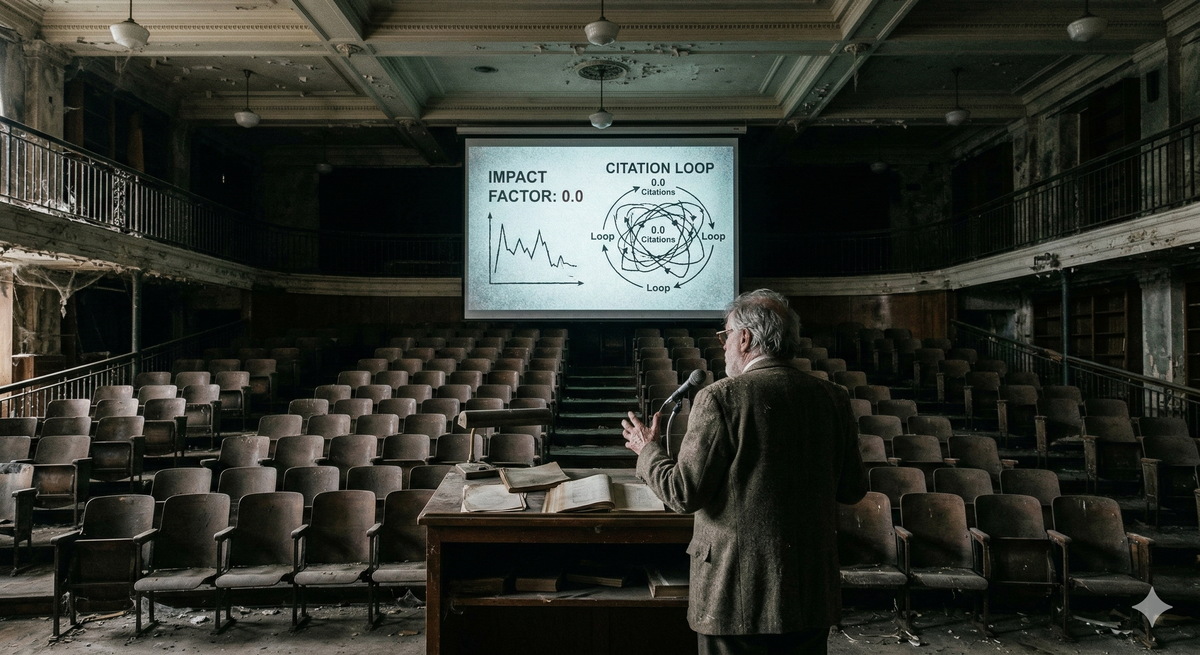
The university is not a place where knowledge is produced, but rather where the concept of “knowledge” is emptied of meaning and transformed into a simulacrum. The social scientist analyzes not the real pains of the outside world, but the indicators of their own academic standing (impact factor, citation counts). This is what Jean Baudrillard calls the simulation of the non-existent, which, by imitating itself, gradually distances itself from the object of study and loses all connection to the real world. Academic knowledge is in the same situation. Young academic candidates study what “successful” examples before them have done and worked on, and try to satisfy their professors.
Everyone has a simulacrum in their mind, and within the framework of the suitability of their work to this simulacrum, they create a group of talented people who are useless, or worse, have become part of a pyramid scheme. I call this a pyramid scheme in no uncertain terms because if it does not enable university students to increase their power in the job market, they will find no one waiting at their doorstep. Universities can still provide people with a profession because they are the primary condition for influencing employers of university graduates and because they are places where a number of performative actions are carried out. As the supply of university graduates increases in this way, it actually diminishes the value of the graduate.
While this is the situation for students, the situation is much more dire for academics. The university no longer produces knowledge; it offers a “hyper-reality” that pretends to produce knowledge. Articles, citations, and conferences are a closed game of signs with no connection to the reality of the outside world. The academy stifles knowledge by forcing it into academic formats, thereby nullifying its revolutionary and practical power. True knowledge production begins when rules are broken. However, universities exclude those who do not conform to the rules (methodology) by declaring them “unscientific.” Just like the Inquisition burning heretics. Today, many people who strive to produce knowledge are not covered in university courses. Because they do not speak from within the academic pyramid. The scientific method is a ritual that serves to protect the institution rather than to discover the truth. Lectures and conferences have become routine communion rituals.
Just as the church lost its power to transform society over time and became a structure that consoled itself only with “Sunday services,” the social sciences also became a structure that could not influence the street, the state, or the individual. Just as a monk devotes his life to decorating a manuscript, an academic devotes his life to the methodology of an article that no one will read. The fact that articles are not read is not the problem here.
Most of those who carried out the French Revolution and subsequently seized power had not read Voltaire or Rousseau. The best-selling books before the revolution are well known. These were erotic novels written by secondary authors who had read and absorbed the writers who would form the ideology of the revolution, and which attacked the monarchy. However, academic articles and books are no longer being read even by those who will transform society and politics. The academy does not know who these people are either. Until he was shot, no professor at the university knew who Charlie Kirk was, or who Nick Fuentes is today. These people also do not read academic knowledge, but they have the power to influence society. Knowledge production is not about creating social policy, but about advancing to a higher level in the academic hierarchy. So, when stripped of all priestly robes, we are left with nothing more than a civil servant who performs the necessary tasks until their appointment arrives.
Feyerabend's observation still holds some validity. The state allocates a budget to the university because a modern state cannot be imagined without a university. Just as a king keeps a priest in his palace. However, the state does not consult academics when making decisions. Academics are merely in the position of a “court advisors” who legitimizes decisions in “scientific language” or talks to himself in a corner.
In short, when the church was demolished, there was a university to take its place. Now the university is being demolished, but there is no institution to take its place. Even when it lost the lands it collected church revenues from, church managed to survive. But the university has no such followers. Perhaps closing the university is the first condition for liberating thought. It is not as difficult as closing the church; it is in such a rotten state that it will collapse into itself the moment we cut the state budget.
-Montreal - 9 March 2026